
The Accuracy Paradox: Why Predictive Precision Fails to Drive Operational Outcomes
Written By: Kevin Blankenship | Forward Deployed Engineer
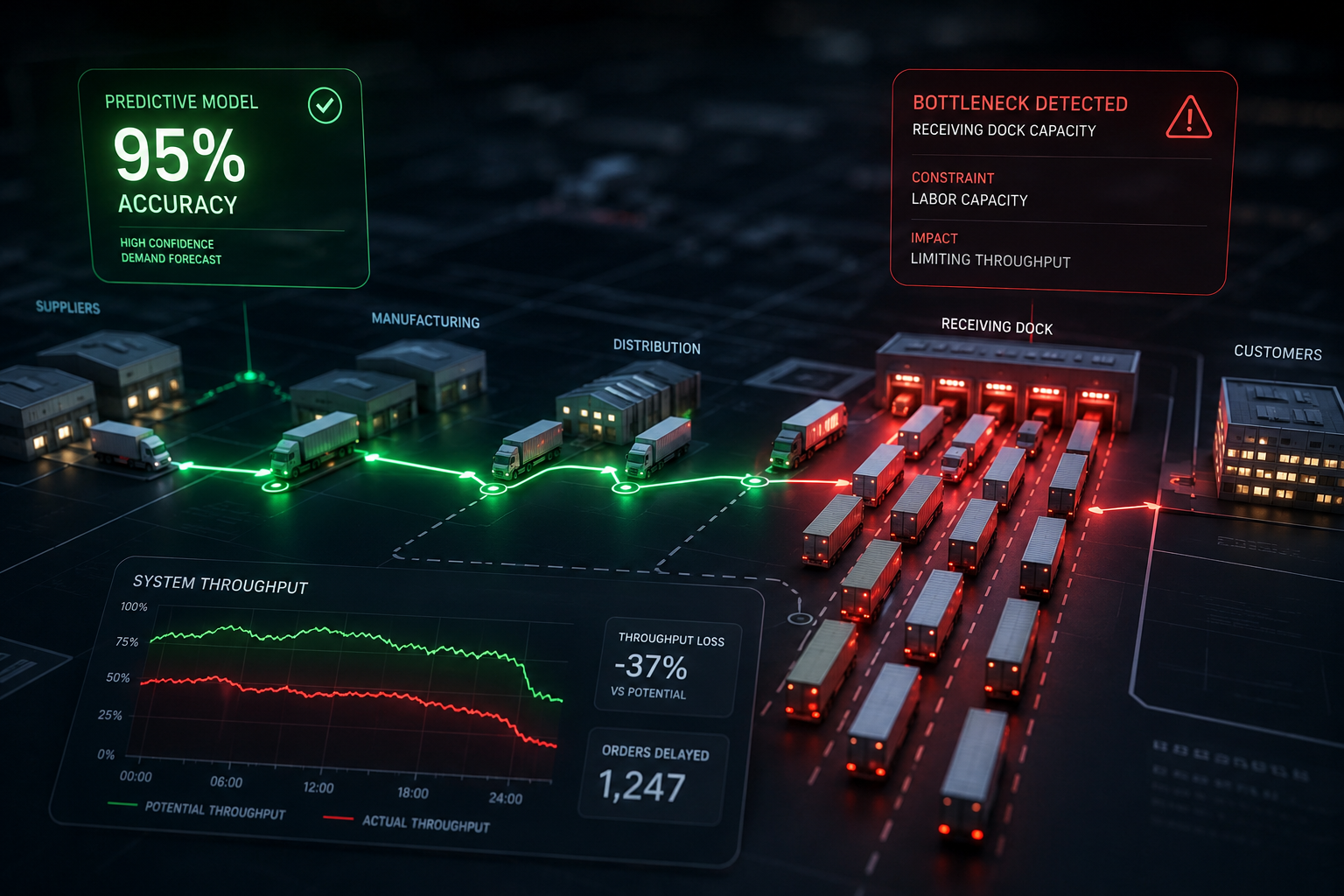
In the current landscape of enterprise data strategy, a specific contradiction has emerged. It is the Accuracy Paradox. Organizations are successfully deploying models with 95 percent or higher predictive accuracy, yet business throughput remains stagnant. The investment in sight has not translated into reach.
This disconnect suggests a fundamental category error in how decision intelligence is applied. To bridge this gap, leadership must move beyond the allure of statistical patterns and toward the rigorous engineering of causal interventions.
The Distinction Between Patterns and Plans
The most persistent source of confusion in modern analytics is treating all decisions as the same kind of problem. In the framework popularized by Lorien Pratt, it is critical to distinguish between pattern-based decisions and causal decisions.
Pattern decisions are centered on recognition. They ask what is likely to happen given what is known. This is the realm of traditional machine learning and forecasting. While valuable, these models are essentially high-definition rearview mirrors. They map observed situations to historical outcomes without explicitly modeling how a specific action will change the world.
Causal decisions are centered on intervention. They ask what should be done to produce the outcome we want. These require an explicit representation of the business physics. This means mapping the causal links between objects, actions, and consequences. Prediction alone is passive. Causality is the engine of change.
The Compute Heuristic: Stop Wasting AI on Patterns
Making the distinction between patterns and causal plans offers a massive financial advantage. It dictates when an organization should actually leverage artificial intelligence.
Organizations have been solving pattern decisions for decades. While complex pattern recognition requires advanced machine learning, the vast majority of operational pattern decisions are entirely deterministic. Using computer vision to identify a defective part or a natural language model to parse an unstructured contract justifies artificial intelligence. However, standard operational rules can be handled by traditional software or basic algorithms. An enterprise does not need to burn expensive LLM tokens or massive cloud compute to solve an inventory threshold problem that was already solvable in 2015.
Causal decisions are different. They require insight, exploration, and reasoning across a complex digital twin. ForgeSight has deployed this framework as a strict compute heuristic for enterprise clients. Deterministic pattern decisions are routed to fast, low-cost processing layers. While targeted machine learning is deployed for complex pattern recognition, the heavy, exploratory power of Generative AI and LLMs is reserved for causal decisions. This is where advanced reasoning is actually required to simulate a business intervention. This discipline ensures that the right tool is used for the right problem. It drastically reduces compute expenses, slashes processing time, and ensures organizations are only paying for heavy AI compute when it actually drives an outcome.
The Strategic Filter: Theory of Constraints
Even a causal model will fail if applied to the wrong part of the system. This is where the Theory of Constraints, pioneered by Eliyahu Goldratt and expanded by Dr. Alan Barnard, becomes the necessary filter.
In any complex operational system, there is only one bottleneck at any given time. Applying high-performance tools to a non-constraint is a form of local optimization. A common failure in AI initiatives is the “kicking the can” phenomenon. High-speed data ingestion is not inherently wrong. Real-time decisions require low-latency data. Theoperational failure occurs when high-speed pipelines feed into a data swamp rather than an active logic layer. This optimizes a single lever without considering total system dynamics.
Consider the application of a predictive model to a physical supply chain. An organization might deploy a sophisticated algorithm to optimize freight routing, accelerating the speed at which shipments reach a regional distribution center. However, if the true constraint is labor capacity at the receiving dock, the AI has not solved a problem. It has merely accelerated a traffic jam.
Furthermore, constraints are dynamic. The moment a causal intervention breaks the labor constraint at the receiving dock, the bottleneck instantly shifts elsewhere. It might move to warehouse storage capacity or outbound logistics. If the system does not dynamically re-identify the new constraint, it will keep optimizing yesterday’s problem. AI must be governed by a framework that respects total system throughput and hunts the shifting bottleneck.
Engineering the Infrastructure for Action
To solve the Accuracy Paradox, the technical architecture must reflect operational reality. This requires a transition from data exploration to decision engineering. The process involves three distinct layers:
Empirical Pattern Mining:
Constraints are often held in place by faulty assumptions. The ERP might assume a process takes four hours, but the floor workers know a broken machine makes it take six. Tools like Palantir Foundry Machinery mine the actual process logs to reveal empirical reality. They flag deviations from the expected path, helping to continuously refine the system and reduce hallucinations caused by incomplete or inaccurate assumptions.
The Causal Digital Twin:
The heart of the operation is a logic-anchored Ontology. This is not a static data model or a brittle database that becomes technical debt in six months. It is a dynamic, version-controlled representation of the organization’s causal links. Crucially, the Ontology does not dictate the objective function. It simply maps the physics. It models what will happen if alever is pulled. The human operator decides if that outcome aligns with business values.
Closing the Feedback Loop:
A decision is not a decision until it is executed. Modern platforms move the output from a static dashboard to an Action Hub. By anchoring generative logic in the Ontology through applications like AIP and Workshop, the system stages interventions designed to break the identified constraint. It does not execute autonomously. The Action Hub simulates the outcome and presents the risk trade-offs to a human. It might calculate that an intervention increases throughput by 10 percent but carries a 15 percent risk of delaying Tier 1 customers. It is augmented execution with strict guardrails. The system provides the causal math. The human provides the judgment.
The Foundational Requirement: Trust and Governance
The psychological barrier to adopting these systems is often a lack of foundational trust. As Cassie Kozyrkov highlights, the responsibility of the decision remains with the human. If the data is ungoverned or the logic is a black box, the system will be ignored the moment it contradicts a leader’s intuition.
Building this trust requires a commitment to three principles:
• Data Provenance: Every recommendation must have a clear chain of custody back to the source record.
• Traceable Reasoning: The system must move from generative guesses to glass-box logic that explains the causal path to a conclusion.
• Safe Simulation: Leaders must be given the space to test their intuition against the causal model and view the uncertainty. When a simulation shows that a gut feel choice will hit a bottleneck while the causal path clears it, the trust gap closes.
The Decision Architect's Mandate
The objective of the next era of enterprise technology is not to build the most accurate model. It is to achieve the highest decision throughput.
The organizations that win the next decade will stop buying AI features and start building causal infrastructure. Engineering teams should not spend 80 percent of their time fixing data ingestion pipelines for models that do not drive action. They should be building glass-box ontologies that scale without the technical debt.
If current AI initiatives are optimizing non-constraints, capital is being burned. It is time to run a Decision Audit to map existing logic against actual system bottlenecks. Find out what the models are missing, and start orchestrating real operational outcomes.
Further Reading for Decision Architects
If you are ready to stop optimizing non-constraints and want to dive deeper into the physics of business decisions, here is where to start:
• On Decision Intelligence: Read Link: How Decision Intelligence Connects Data, Actions, and Outcomes for a Better World by Lorien Pratt. This is the foundational text on moving from predictive patterns to causal actions.
• On System Bottlenecks: Read The Goal: A Process of Ongoing Improvement by Eliyahu M. Goldratt. It is a business novel that introduced the Theory of Constraints. It is mandatory reading for understanding why local optimization is destroying your throughput.