
Foundry's Second Act : Steering The Ship
Part 2 of 4
Written By: Johan Gauffin
This article in brief:
The challenge is that Foundry programs often stall after early pilots because the organization treats scaling as an IT expansion rather than as a set of business decisions about priorities, risk, and accountability.
The idea is that executive governance such as clear decision rights, clear sponsors, and a repeatable forum for trade-offs, turns Foundry from a collection of promising efforts into a platform that compounds value.
The takeaway is that if Foundry is mission-critical, leaders must steer it like any other strategic asset: by owning the decisions that determine investment level, scope, standards, service expectations, risk tolerance, and who is accountable for outcomes.
Steering Foundry: Executive Governance and Decision Rights
In the first phase of a Foundry journey, the leadership team’s challenge is strategic unification: deciding what the platform is for and how it will advance business outcomes. The second phase is less glamorous but more determinative. It is governance.
This post is written in the same spirit as Part 1: ForgeSight is not selling Foundry. This series is for leadership teams who have already invested in the platform and are now working through the harder question of how to scale value across functions, sites, and business units.
As long as Foundry stays a set of pilots, the organization can tolerate ambiguity. When Foundry becomes a platform, ambiguity becomes expensive. Without governance, priorities drift, standards fragment, and delivery becomes a case-by-case negotiation. The result is predictable: a technically capable platform that struggles to produce a durable business impact.
Why Governance Becomes the Bottleneck After Pilots
Most executive teams intuitively understand that large systems fail when they are treated as “IT projects.” Yet the pilot-to-platform transition invites exactly that failure mode. Leaders assume that “scaling Foundry” is primarily a delivery problem requiring more engineers, more integrations and more apps, when the real constraint is decision-making: who decides what Foundry is used for, how much to invest, where to focus, and what “good enough” looks like.
Governance is simply the operating system for those decisions. It is the mechanism that turns executive intent into repeatable choices and prevents a platform from becoming a patchwork of well-intentioned exceptions.
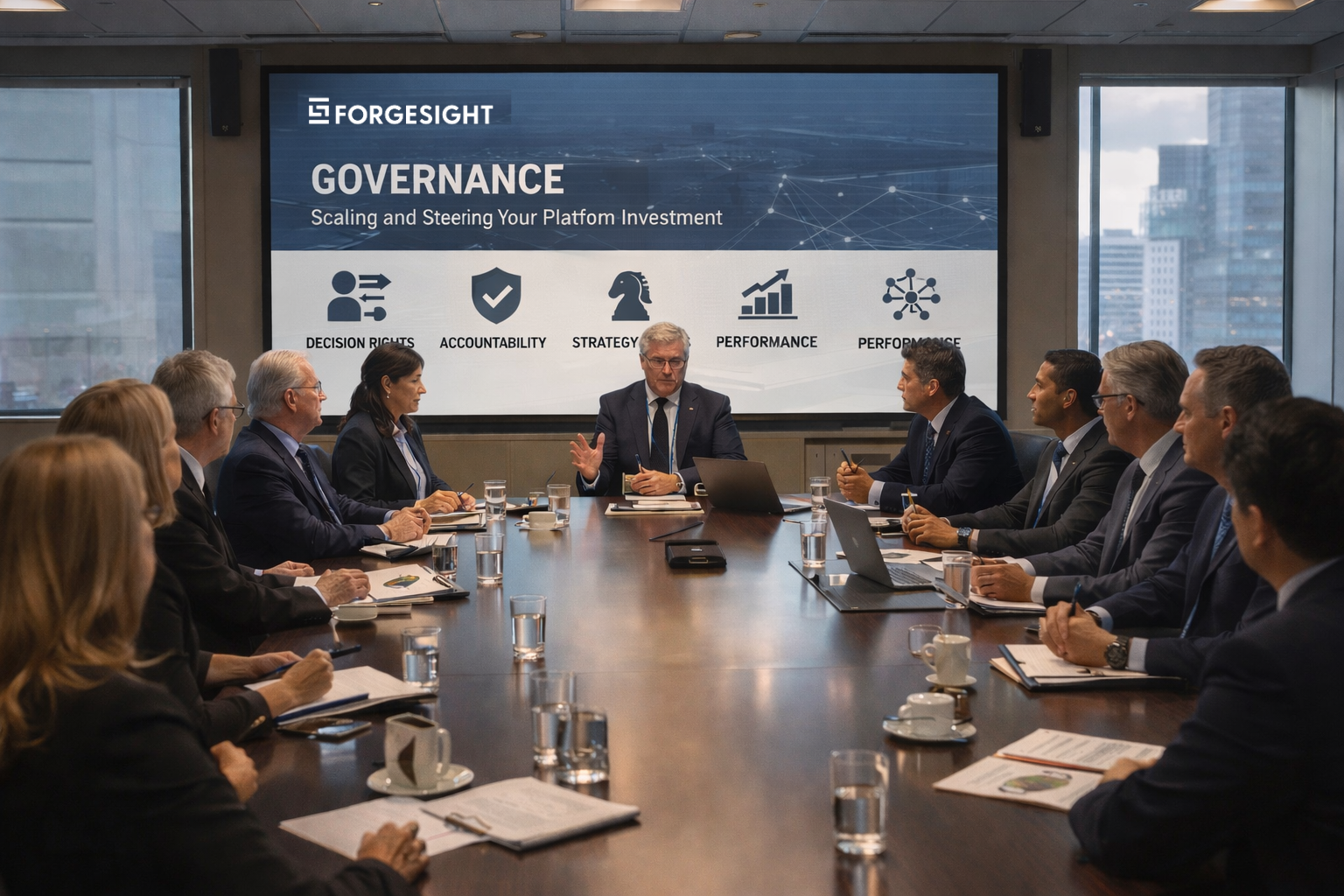
Decision Rights are the Hidden Architecture of Scale
In mature digital organizations, senior leaders do not micromanage technology. They do something more important: they define decision rights and accountability so that the system can scale without constant escalation.
Foundry governance works when leaders establish a small set of recurring decisions that must be owned at the executive level, then create a forum that makes those decisions consistently, with the right input, and with clear accountability for outcomes. This shifts Foundry from “requests and deliveries” to “portfolio and performance.”
Forward-Deployed Engineering Still Works, and Better Governance Makes It Scale
Nothing in this governance discussion is a critique of forward-deployed engineering. If anything, the FDE model is one of the most effective ways to deliver value quickly in complex operational environments. When engineers work shoulder-to-shoulder with the people closest to the process, they surface real constraints, iterate faster, and build solutions that reflect how work actually gets done, not how it is described in a requirements document.
The risk emerges when that closeness becomes the only steering mechanism. End users are experts in their slice of the operation, but they are not always positioned to see the full value chain, the cross-functional trade-offs, or the second-order impacts of “local optimizations.” In a platform program, those blind spots are not a failure of the users; they are a structural reality. Without governance oversight, the FDE team can end up unintentionally optimizing for what is most urgent or visible within a single function, while underinvesting in the shared foundations of standards, reusable assets, common data models, and adoption mechanisms that determine whether Foundry scales across the enterprise.
Governance is what turns FDE from a series of high-impact engagements into a compounding system. It provides direction without slowing delivery. It clarifies where FDE capacity should be deployed, what “value” means for the enterprise, which standards are non-negotiable, and how success will be measured beyond shipping a solution. In other words, governance doesn’t replace forward deployment; it protects it. It ensures that the speed and intimacy of FDE work are harnessed toward outcomes that are strategically aligned, repeatable, and governed so the platform delivers value fast and keeps delivering value as it grows.
The Six Decisions That Determine Whether Foundry Compounds Value
A practical way to make governance concrete is to focus on a small set of decisions that, if left implicit, will be made anyway, just less coherently. For Foundry, as for any large decision companies have to make around IT and systems, six decisions tend to dominate whether the platform scales value or scales complexity.
- The first is the investment decision: how much the firm will spend on Foundry, and what that investment is expected to return.
- The second is the prioritizing decision: which business processes deserve Foundry capacity, and which do not, especially when the backlog is long, and every request sounds reasonable.
- The third is the standardization decision: which Foundry capabilities should be enterprise-wide, such as data models, core ontologies, shared assets, and which should remain local or specialized.
- The fourth is the service-level decision: how reliable, real-time, and “Cadillac” Foundry needs to be for different types of use cases, so the organization avoids both over-engineering and under-delivering.
- The fifth is the risk decision: what security, privacy, and compliance posture the firm will adopt, and what trade-offs it is willing to accept in exchange for speed and interoperability.
- And the sixth is the accountability decision: who owns the outcome when a Foundry initiative under-delivers, not whether the tool was shipped, but whether the business value was realized.
Taken together, these decisions determine whether Foundry becomes a mission-critical platform governed like a core asset or a high-performing technical environment that struggles to drive change in the business.
Governance Needs a Forum, Not a Heroic Executive
These decisions do not get made well in one-off meetings. They require a standing mechanism with continuity, context, and authority. That is why the most effective organizations establish an executive steering forum, often an IT steering committee or digital council that exists to arbitrate trade-offs and keep investments aligned to strategy.
A Foundry steering committee works when it includes executives whose incentives need to align for scale to happen. In a regulated supply chain context, that typically means an operations leader, a technology leader, a supply chain leader, finance, and a compliance or quality representative. The point is not to create bureaucracy; it is to create one place where the organization can make cross-functional decisions without devolving into silo-by-silo optimization.
The committee’s job is also to set principles that reduce friction downstream. When leadership clarifies the principles around what Foundry is the default platform for, what standards are non-negotiable, and what needs enterprise consistency, many decisions can be safely delegated because the guardrails are real.
Sponsorship is Where Governance Becomes Value
Governance fails most often at the point where accountability becomes uncomfortable. A platform initiative can “succeed” from an IT perspective and still fail the business. The tool ships, the data flows, the app exists but adoption stalls, processes don’t change, or incentives remain misaligned. Value never materializes.
That is why executive sponsorship is not a ceremonial role. A Foundry sponsor must have authority over the business process being changed, the time to drive adoption, and the standing to coordinate with IT on metrics and iteration. In practice, the sponsor is the person who can answer the only question that matters after launch: what changed in the business because this ability exists?
When that sponsor role is explicit, and when performance expectations include adoption and benefit realization, Foundry stops being perceived as “something IT is doing” and becomes an operating model upgrade led by the business.
Governance is Not a Phase; It is a Discipline
Foundry scale introduces new decisions continuously: new data sources, new user groups, new regulatory requirements, new opportunities to automate or optimize. Governance is the system that allows the organization to absorb those decisions without losing coherence.
Done well, governance also evolves. The right decision rights early, often more centralized, may not be the right decision rights later, when the organization wants to federate development while keeping standards consistent. The goal is not a perfect design up front. The goal is a living system that keeps Foundry aligned with business value as it grows.
Next in the Series
In Part One, we discovered how strategic alignment sets the direction for successful Foundry adoption. Part Two showed how governance provides the structure and discipline needed to guide that journey.
In Part Three, we’ll explore what governance actually enables: the organizational change that happens when Foundry stops being “just a tool” and becomes the way work gets done. This is where adoption becomes structural and where the platform’s value either compounds or gets stuck in a cycle of constant reinvention.
Acknowledgments
With thanks to Ben Menesi(LinkedIn) and Percy Rivera Salas(LinkedIn) for reviewing earlier drafts of this piece and offering thoughtful feedback that strengthened the argument and improved clarity. Any remaining errors or omissions are mine alone.
References and further reading
Ross, Jeanne W., and Peter Weill. “Six IT Decisions Your IT People Shouldn’t Make.” Harvard Business Review (November 2002).
Eastwood, Brian. “4 levers that create digital value.” MIT Sloan Ideas Made to Matter (October 16, 2023).
Pratt, Mary K. “Transforming IT for digital success.” CIO (October 23, 2023).
Author’s note:The governance framing in this article was informed by coursework and class discussion in Prof. Suchit Ahuja(LinkedIn)EMBA 621 (Information Technology: Digital Strategy, Analytics & Transformation), Executive MBA, Concordia University (Winter 2026).