
Foundry's Second Act
Part 1 of 4
Written By: Johan Gauffin
Series Introduction:
Many organizations investing in Palantir Foundry experience the same pattern: early pilots demonstrate real promise, but scaling that success across the enterprise proves far more difficult. The challenge is rarely technical. It is strategic, organizational, and operational.
This four-part series explores how leadership teams can move beyond successful proofs of concept and turn Foundry into a durable enterprise capability. Across the series, we examine the strategic, governance, and organizational questions that determine whether Foundry becomes a transformational platform – or stalls as another promising pilot.
Each article will unpack a different dimension of the scaling challenge, from defining the platform’s strategic role, to establishing governance and decision rights, to navigating the organizational change required to fully realize its value.
Overview
The challenge is that many Foundry programs stall after early pilots because “scaling” is treated as expanding the platform footprint rather than scaling business outcomes.
The idea is to treat Foundry as a strategic asset by disciplined planning that clarifies its role, defines success measures, and imposes portfolio and sequencing logic.
The takeaway is that when governance and decision rights are explicit, Foundry becomes part of the enterprise operating system, where value compounds instead of resetting with each new initiative.
Turning Promising Pilots Into Enterprise Value
Most executives don’t struggle to justify their investment in a platform like Palantir Foundry. The strategic logic is simple: unify fragmented operational data, shorten decision cycles, and build resilience into the business. The harder question emerges later, usually after the first handful of pilots have been celebrated and the organization tries to scale the effort. At that point, the platform is no longer the story. Execution is.
ForgeSight’s role in this conversation is intentionally narrow. We are not selling Foundry. This series is written for leadership teams that have already made the platform investment and are now facing a more practical challenge: how to convert early proof into durable, enterprise-wide value.
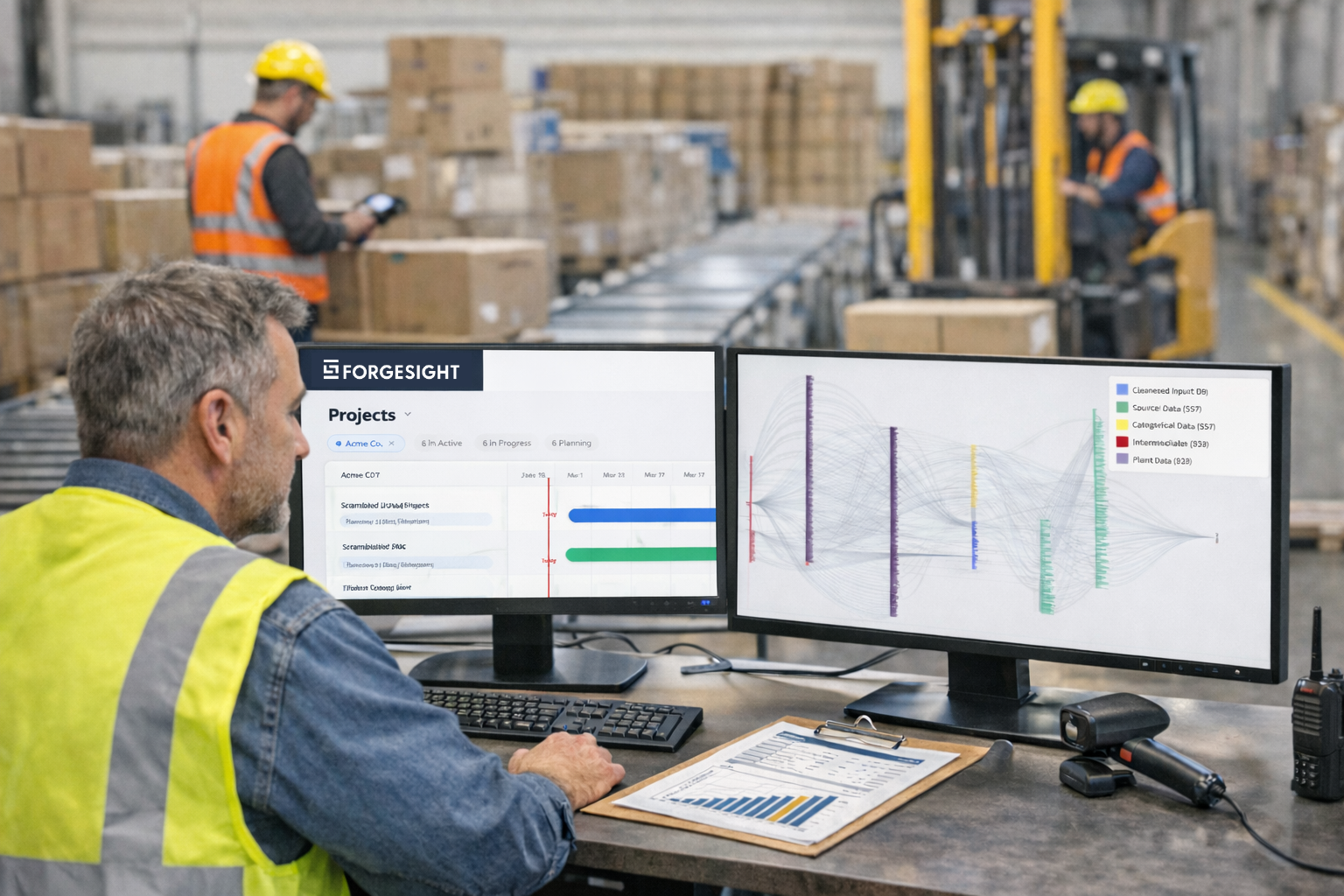
The Post-Pilot Plateau
That challenge is not unique to any one industry, but it shows up with particular intensity in supply chains, where operational dependability and compliance pressures make “good enough” transformation efforts expensive. Many programs begin with strong momentum, just to then stall in a familiar middle ground: a set of promising proofs of concept, a growing backlog of requests, and an uncomfortable sense that the organization is doing a lot of work without a proportional increase in outcomes.
The turning point often comes when an executive asks the simplest question in the room: What, precisely, are we scaling?
What We Scale is NOT the Platform
The implicit answer is usually “Foundry.” But that is not an outcome. Scaling Foundry to more data sources, more pipelines and more applications can be valuable, but only when it is subordinate to a business strategy that dictates what the platform is for. The white paper’s core argument is that moving from ad hoc pilots to enterprise impact starts with strategic planning: treating Foundry as a core asset rather than another IT experiment.
Strategy First: Defining Foundry's Role
This is where Strategic Information Systems Planning (SISP) becomes useful. SISP forces the leadership team to answer a question that most platform programs postpone for too long: how will the Foundry platform drive business value, and what resources and projects are required to realize that value? The question matters because value stalls most often not when the technology fails, but when leadership never clearly defines the role the technology is meant to play.
When that role is undefined, the organization compensates by taking on greater ambition. It declares a mandate that sounds visionary and all-encompassing, something like connecting all data for everyone, then discovers it is operationally ungovernable. To repeat a classic warning: an expansive, non-specific information mandate can absorb millions and still deliver elusive benefits. The issue is not effort. The issue is design.
The alternative is intentionality. In dealing with distribution and supply chain, strategic intent is usually not abstract. It takes the form of concrete business problems: improving levels, reducing shortages, accelerating time-to-market, or optimizing cost-to-serve. The practical move is to anchor Foundry to those aims in language the enterprise can fund, measure, and govern, positioning Foundry as the mechanism for live supply chain transparency so that inventory levels are available where and when they’re needed.
Measurement, Investment, and Portfolio Discipline
Once Foundry’s strategic role is explicit, the next constraint surfaces immediately: measurement. If the executive team cannot agree on how to judge success, the program’s legitimacy becomes fragile. That is why SISP insists on translating intent into targets and metrics, not to satisfy reporting, but to focus delivery on business value. In practice, this is where leadership shifts the platform conversation from capability to consequence. Instead of asking what Foundry can do, the better question becomes: how will we know Foundry is promoting our strategy?
This is also where investment decisions become rational. Foundry programs frequently inherit a budgeting problem disguised as an engineering problem. Teams are asked to “scale,” but no one has articulated what scale is worth, which makes the spending discussion either political or purely benchmark-driven. Defining objectives enables leadership to answer the investment question deliberately, “how much should we spend on Foundry?”, based on expected strategic contribution rather than on technology trends.
Then comes the moment most organizations try to skip: portfolio discipline. In the absence of strategic guardrails, Foundry programs accumulate a long list of initiatives that are individually reasonable and collectively incoherent. SISP’s practical output is a prioritized portfolio that forces each use case to justify itself against the strategy. This is not simply a project management exercise. It is an executive responsibility because the trade-offs are business trade-offs. The program becomes scalable when leadership is willing to double down on the few initiatives that truly advance strategic priorities and pause the ones that do not.
For supply chain implementations, the portfolio conversation should feel uncomfortably concrete. If resilience is the strategy, then initiatives that anticipate and prevent stock-outs should outrank attractive but low-leverage work. Without that clarity, the organization risks investing capacity in “nice to have” applications that create activity but not advantage.
Even when the portfolio is right, sequencing matters. Many Foundry transformations fail not because the destination is wrong, but because the organization tries to reach it in one step. SISP encourages leadership to think in terms of an IT roadmap: creating foundational integration first, then building advanced analytics, then moving into more transformative capabilities. The point is not to prescribe a universal timeline, but to underscore that early wins should be chosen and engineered to build momentum and capability for the next phase.
Making Foundry Part of the Operating System
This is the moment when Foundry stops living in the innovation lab and starts earning its place in the enterprise operating system. Strategic framing does more than prioritize work; it legitimizes the program. It signals that Foundry is “how we will do business going forward,” supported by governance, funding models, and talent development, not a rotating experiment. Once that signal is credible, adoption becomes less of a change-management campaign and more of a structural outcome: the platform is where decisions are made because the enterprise has designed itself that way.
That is also why governance cannot be an afterthought. A platform that affects how the enterprise allocates capital, sets priorities, and manages accountability must be steered with explicit decision rights. The next piece in this series will go there directly, focusing on the executive governance structures and key IT decisions around prioritization, funding and accountability that keep Foundry aligned with enterprise goals as it scales.
If you are already invested in Foundry and still feel stuck in the middle, the diagnosis is often simpler than it seems. It is rarely a matter of whether the platform is capable. It is a matter of whether the enterprise has been equally rigorous about strategy, measurement, prioritization, sequencing, and governance. SISP is not a slogan; it is a discipline that turns Foundry from a technology project into a business program with executive oversight and tangible targets; the conditions under which scale becomes not only possible, but repeatable.
Acknowledgments
With thanks to Ben Menesi, Monica Lee, and Neil Cooke for reviewing earlier drafts of this piece and offering thoughtful feedback that strengthened the argument and improved clarity. Any remaining errors or omissions are mine alone.
References and further reading
Ross, Jeanne W., and Peter Weill. “Six IT Decisions Your IT People Shouldn’t Make.” Harvard Business Review (November 2002).
Eastwood, Brian. “4 levers that create digital value.” MIT Sloan Ideas Made to Matter (October 16, 2023). https://mitsloan.mit.edu/ideas-made-to-matter/4-levers-create-digital-value
Pratt, Mary K. “Transforming IT for digital success.” CIO (October 23, 2023). https://www.cio.com/article/656500/transforming-it-for-digital-success.html
Author’s note: The governance framing in this article was informed by discussions in EMBA 621 (Information Technology: Digital Strategy, Analytics & Transformation) at Concordia University (Winter 2026, Suchit Ahuja).